How to Write a Useful Game Playtest Task
A useful game playtest task tells the player what they are trying to achieve while leaving the route open. Before your studio records a session, check whether the wording accidentally names the menu, item or action you wanted to learn about.
Decide what the task can tell you
Separate two questions: can players complete a goal when asked, and do they notice that goal during ordinary play? An assigned task can help investigate the first. It cannot, by itself, establish the second. If spontaneous discovery is the question, observe an uninterrupted stretch of play before introducing the task.
The GOV.UK usability-testing guidance recommends believable goals, neutral instructions and tasks that do not reveal how to complete them. Our recommendation is to apply that principle to the specific game behavior you want to observe.
Describe the situation before the solution
Consider a hypothetical survival game. The research question is whether players understand how to prepare for a cold crossing. “Open Crafting, select Insulated Coat and equip it” has already supplied the intended route. A more useful task might be: “You need to reach the relay across the frozen valley. Prepare your character, then begin the crossing.”
Keep the research question and expected route in the observer’s notes. Record the starting save, available resources and prior tutorial exposure so later reviewers know what the player could reasonably have understood. Accept alternative solutions that genuinely satisfy the goal; following a different route is not automatically a failure.
That instruction still announces the crossing and the need to prepare. If you want to know whether the game communicates those ideas unaided, do not use completion of this prompted task as the evidence.
Keep every hint in the record
Agree beforehand when the observer may help and what they will say. If someone supplies a hint, retain it in the recording and note its timestamp and exact wording. Distinguish completion before help from completion after help. An edited clip that removes the prompt can change the apparent meaning of the result.
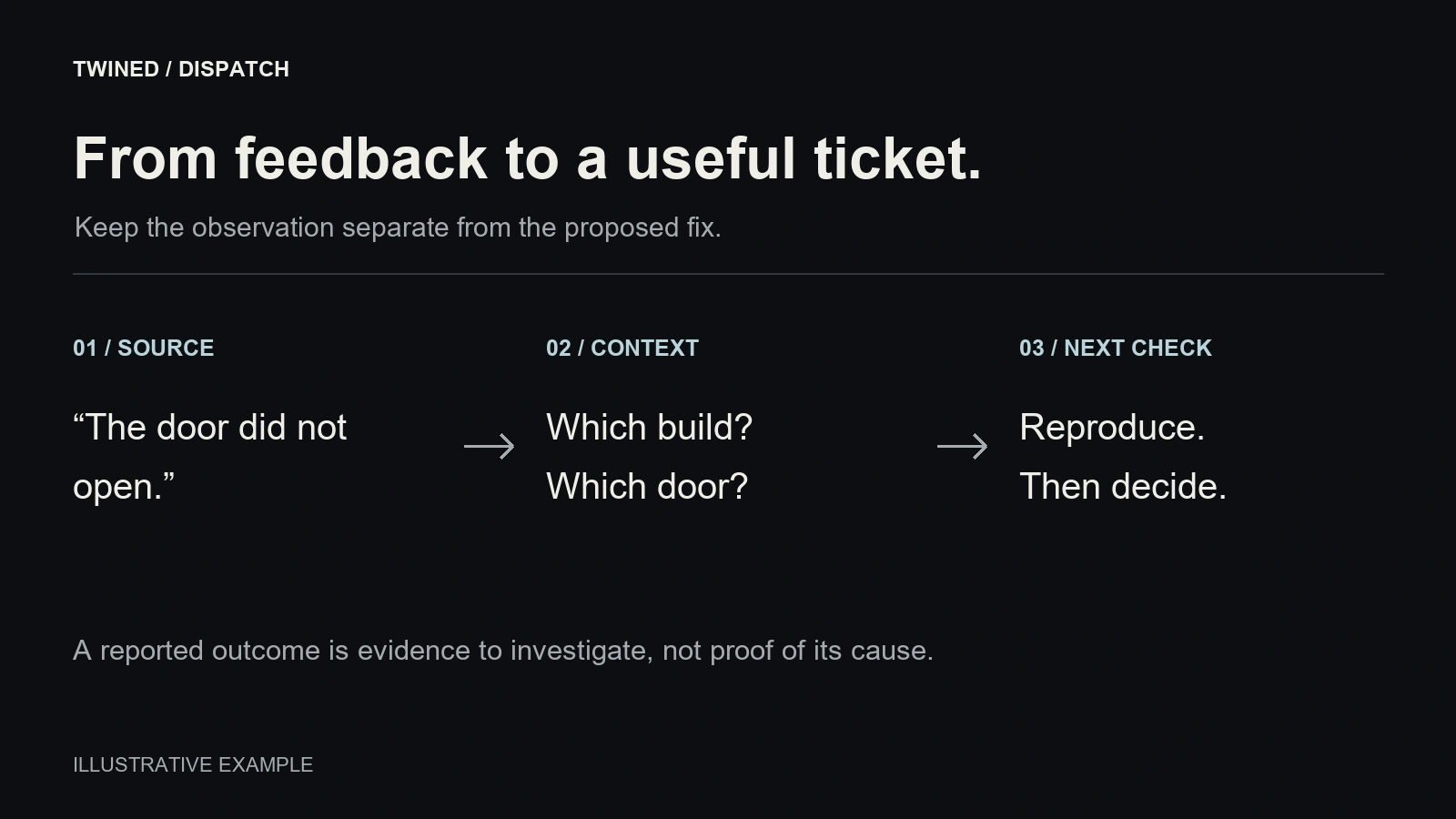
For review, send the original task wording, build and starting-state details, recording and intervention notes together. For reported player comments, our feedback-to-ticket article shows how to preserve uncertainty when choosing the next action.
Twined’s Playtest Analysis reviews recordings supplied by your studio. Share the question you want to investigate to discuss timestamped observations and practical next checks.